Showing posts with label missiles. Show all posts

Sunday, December 14, 2025

Drones are the most considerable new weapon systems.


Above: MQ-28 "Ghost Bat" launches AMRAAM. These types of drones. It can also carry air-to-ground missiles and anti-radiation missiles. Like. AGM-88 HARM and other smaller drones. 

Drones are a new and effective threat. The reason why drones are so hard for defense is that their development cycle is much faster than that of any manned systems. Drones are cheap to build. And their operators' training. It is fast. And cheap. A drone doesn’t need life support systems. 3D printing systems. Make it possible for drones. To be customized for each mission. 3D printing systems can be installed in ships or trucks. And they can create drones from plastic, carbon fiber, or metal wires. This means those drones require only microchips. And engines. And explosives to make effective surprise attacks. 

The fact is that drones don’t need any explosives to be dangerous. They can roll metal wires around high-voltage power lines. Those systems can also have Kevlar whips. They have a metal bite at their end. And those whips can hit targets with supersonic speed. The Shahed-136 and Geran-3 type drones can strike targets from 1000 km distances. Those drones are used to drop mines in Ukraine. Those drones can also drop other drones whose mission is to cause damage and suppress air defense. The AI-based programming makes those drones very independent. And that makes it possible. Those drones are left behind enemy lines. And then they can be activated remotely. This means those drones can sit and wait for their orders. A drone can attack things like submerged targets. This means they can be dangerous. To full-size submarines. And it's possible. 

That the full-size nuclear submarines can be converted into sea drones. A submarine’s nuclear reactors. Can deliver energy. For. A full-size supercomputer. This type of system can drive complex algorithms. Things like torpedo tubes are easy to convert for automatic reload. Torpedoes and missiles can be stored in long tubes. The system mimics the firestorm system, but it uses torpedoes. And that allows the submarine to launch them at a very high rate. Large-sized submarine drones can carry large nuclear warheads. And that means. The system. Can carry. 4-5 “Tsar bomba”-type warheads (50mt.) along with torpedoes and missiles. That means the Russian “Poseidon” system can be a child’s game. Compared to systems that are coming. 


"China’s heavyweight jet-powered Jiutian drone, said to have a maximum takeoff weight of around 17.6 tons (16 metric tons), has flown. A key mission for the design is expected to be acting as a mothership for swarms of smaller uncrewed aerial systems, as TWZ has explored in the past. It has also been shown previously armed with various air-to-surface and air-to-air munitions, and could perform a variety of other missions, including airborne signal relay and logistics." (TWZ.com, China’s High-Flying Swarm Mothership Drone Has Flown)

Things like large-sized drone motherships are also coming into service. Those systems. It can be a new threat and system for dominating battlefields. Those systems can carry kamikaze-drones. But also UCAVs that can operate against other aerial targets. 

Aerial drones. They are classified as unmanned aerial vehicles (UAVs) and unmanned combat aerial vehicles (UCAV). The difference between those drones is not big. Things like kamikaze-drones. Can attack both ground and aerial targets. They can transmit intelligence information from their route. Those drones can also return to base if their weapon systems are not needed. 


"A British MQ-9A Reaper operating over Afghanistan in 2009" (Wikipedia, Unmanned combat aerial vehicle)

The kamikaze drone can also carry things like small air-to-air or anti-radiation missiles. A drone can use those missiles to attack radars and jet fighters. Even a small air-to-air missile can damage the jet fighter. The UCAV can also carry an internal warhead. And that gives them the ability to cause more damage. Internal data links allow the transmission of target information to drones. Remotely. 

Those kamikaze drones can carry other smaller drones, which they can drop into their route. The AI and afterburner will give those drones. An ability to attack aerial objects. Those drones can also operate from any platform, from trucks, potholes, and aircraft. Small drones can be effective against soft targets. Like. Aircraft and helicopters. If. We think about a situation. These small-sized kamikaze drones can slip into the aircraft carriers' hangars. Or drones can also damage aircraft carriers, electronics, and their steam catapults. 

Those weapons can be dropped from other drones or missiles. Or small, remote-controlled speed boats can transport them near those aircraft carriers. Drones can also wait on the beach. They can carry things like missiles, bazookas, and internal explosives. They can close their targets underwater. Rise from the sea. And then slip into the aircraft elevators. Or they can aim their weapons at the radars or the ship’s own missiles. The drone that can drop a bomb into the ship’s missile hatch can detonate the hatch. And then dive itself into that hole, and detonate in the missile tube. 


"The two Global Autonomous Reconnaissance Craft (GARC) assigned to Unmanned Surface Vessel Squadron 3 (USVRON 3) seen here are indicative of the US Navy’s separate ongoing work on smaller USVs. USN" (TWZ.com, Crew Optional Designs Could Be Barred By Law From Navy’s Drone Ship Program)

A drone. Can fly into the air intakes of jet engines. The drone that has image recognition can land from the sky and wait for its target. When a drone. Sees an aircraft or some other target. The AI can give it an order to make a kamikaze mission. The drone can have many types of explosives and warheads. And it can act like mines. A drone can fly through the protective fences and wait near airfields. When it recognizes its target, it can make an attack. The target can be a certain aircraft, tank, other vehicle, or even a person. The image recognition. Doesn’t make a difference between a vehicle and a certain human. 

Drone systems are many times more effective than manned systems. There is no crew; they don’t need things like toilets, water, or food.  Unmanned surface vehicles (USV) and unmanned underwater vehicles (UUV). Those tools that can carry other drones or missiles. Even a small drone can carry anti-tank or other missiles. The USV can have a kamikaze capacity. And it can have a small quadcopter. It can be used for. Search. Targets. 

The small quadcopter that hangs above the USV or unmanned ground vehicle (UGV). The small quadcopter that hovers above them can be wire-guided. That drone can also show targets. For. The drone itself. Or it's laser-guided ammunition. The laser-homing rockets. With. Many types of warheads are installed on jet fighters. But the surface drones can also operate with those rockets. The drone that can point targets to those rockets can make. Precise accuracy. With those rockets. That drone allows operators to shoot those rockets from behind the visual obstacle. And that can make those systems more effective. 


https://www.twz.com/air/american-made-shahed-136-kamikaze-drone-clones-being-tested-by-marines


https://www.twz.com/air/chinas-high-flying-swarm-mothership-drone-has-flown


https://www.twz.com/air/mq-28-ghost-bat-has-fired-an-aim-120-amraam-missile


https://www.twz.com/air/russias-shahed-long-range-drones-are-now-dropping-anti-tank-mines


https://www.twz.com/sea/crew-optional-designs-could-be-barred-by-law-from-navys-drone-ship-program


https://en.wikipedia.org/wiki/Unmanned_aerial_vehicle


https://en.wikipedia.org/wiki/Unmanned_combat_aerial_vehicle


https://en.wikipedia.org/wiki/Unmanned_ground_vehicle


https://en.wikipedia.org/wiki/Poseidon_(unmanned_underwater_vehicle)


https://fi.wikipedia.org/wiki/Tsar-Bomba


https://en.wikipedia.org/wiki/Unmanned_surface_vehicle


https://en.wikipedia.org/wiki/Unmanned_underwater_vehicle


Friday, August 18, 2023

Why have Russian Ka-52 "Alligator" helicopters failed in Ukraine?

Why have Russian Ka-52 "Alligator" helicopters failed in Ukraine?


Many Russian Ka-52 "Alligator" helicopters are shot down over Ukraine. That helicopter should be the competition for the AH-64 Apache and other Western military helicopters. But big losses in Ukraine caused a re-estimation of the use of that helicopter.

One reason for those losses is that the Ka-52 is a very common combat helicopter in Russian forces. One of the reasons why Ka-52 turned into a flop can be that their crews were not trained as they should. And a lack of training causes those losses.

But one of the biggest reasons for Alligator failure can be attributed to a lack of trusted "fire and forget" weapons. If Ka-52 uses rockets aiming at those weapons takes longer time and forces the helicopter to fly straight ahead. The reason why Ka-52 was successful in Syria was there was no heavy AA or lightweight smart missiles. The Ka-52 could hover outside the enemy fire and use its firepower. 

The regular anti-tank missile that is used in those Ka-52 helicopters uses semi-active laser homing. The pilot or gunner sees the target and locks the laser on it. And then the anti-tank weapon called "9K121 Vikhr" rides to the target with that laser. 

The system should be immune to countermeasures, but the weakness is that the helicopter cannot move at all, at least horizontally. The laser system requires a gyroscopic system that keeps it aimed at the target. Without that system the helicopter is vulnerable. 

Or the missile loses contact with the laser ray. Or if the pilot makes some maneuver, the laser ray turns away from the target. If the helicopter hovers in a stable position for about 10–60 seconds, that makes it a good target for any AA system. Because aircraft that use semi-active radar-homing missiles cannot make escape and evasion movements before the missile hits the target, they are vulnerable.

Ka-52 c. 2015


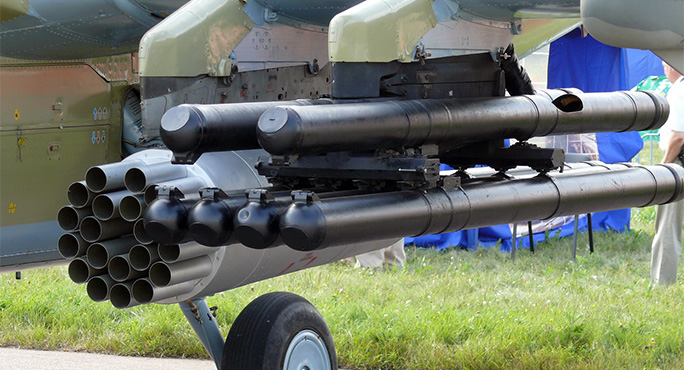
Vikhr missile transport and launching tubes (Wikipedia/9K121 Vikhr)

There is an investigation into the possibility of using semi-active laser homing in Western helicopters. In those applications, the helicopter cooperates with quadcopters or some other drones.

The laser in the helicopter marks a point for the quadcopter that points a laser spot on the target. Then helicopters shoot missiles that can use the quadcopter's laser spot to aim themselves at targets. Or in some other versions, the helicopter drops a quadcopter at the same moment as a missile.

And the missile rides on the laser beam that was shot from the remote-controlled quadcopter. That kind of system gives old-fashioned systems their trusted fire-and-forget ability. In some visions, old-fashioned wire-guided missiles can cooperate with drones like quadcopters. In that system, those control wires will be installed under the quadcopter.

Then the operator of that weapon can use a quadcopter as a launch platform. Another operator can control the flight of that missile by giving it a control signal through the quadcopter. So the remotely controlled unit of wire-guided missiles that is installed below the quadcopter can give that old-fashioned weapon fire-and-forget ability.

The image-based fire-and-forget ability makes the Javelin missiles superior. Because Javelin uses a modified face recognition system (AI-based IIR, or imaging infrared), that missile is hard to jam. Image-homing missiles are hard to jam by using flares.

But optical AI-based image-homing systems have replaced those laser systems. Those systems are used in the Javelin and Maverick missiles. Also, guided bombs can use this type of target designator. In those systems, lasers mark the target for missiles. And when a helicopter shoots a target, it can start to make counter maneuvers against missiles and other hostile fire.


https://www.businessinsider.com/ukraine-destroying-russia-ka-52-helicopters-mobile-artillery-expert-2023-8?r=US&IR=T

https://defence-blog.com/ukrainian-forces-shoot-down-russian-ka-52-attack-helicopter-2/

https://en.wikipedia.org/wiki/9K121_Vikhr


Tuesday, April 12, 2022

What is the difference between drones and missiles?


Russian Iskander missile (Wikipedia)


Missiles are easier to use in war crimes. The missiles need only two coordinates the launching point. And the point where the target is. The missile crew will give the target coordinates to the missile. And then the GPS/GLONASS system tells the missile its location and the distance to the target. When the target is in range, the system simply tells, that it's time to shoot. 

The problem with that kinds of missiles is. They need to update their target's position all the time if the missile wants to hit the moving targets. The CEP (Circular Error Probability) depends on the accuracy of the positioning system. Things like radar and image (or imaging infrared) homing missiles require the position of the target and then the GPS or inertial navigation system will drive the missile to the point, where its trajectory starts to turn to the ground. 

Then the seeker must see the target. If the seeker doesn't see the target the AI must decide does it detonates the missile in airborne. Or would it allow it to impact the ground? The thing is that AI-based imaging infrared systems are the new things and the computer code that is needed is complicated. And the most usual way to make a missile fly to its target is to use GPS/inertial navigation. 

If there is no optical seeker the operators would not even know where they shoot their missiles. So the fault, if the missile hits civilian targets, is the person who gives coordinates to the guidance system. 


Things like UCAV (Unmanned Combat Aerial Vehicles) are made against highly mobile missile systems. The combat drone can patrol for hours or even days and search the targets. And missile systems are the primary objects for small and lethal anti-tank missiles. 

Those drones can observe the ground operations but they are capable to destroy both anti-aircraft and short-range ballistic missiles. They can use along with the manned aircraft or alone against all ground targets. The thing is that the controller of the system sees the target. And if there are some civilians those drone operators should see also that thing. 

The thing is that the high-flying low-enduring drone is always quite a hard target for ground-based systems. The piston engine leaves a very low infrared signature. The question is why Russian military have not those systems?

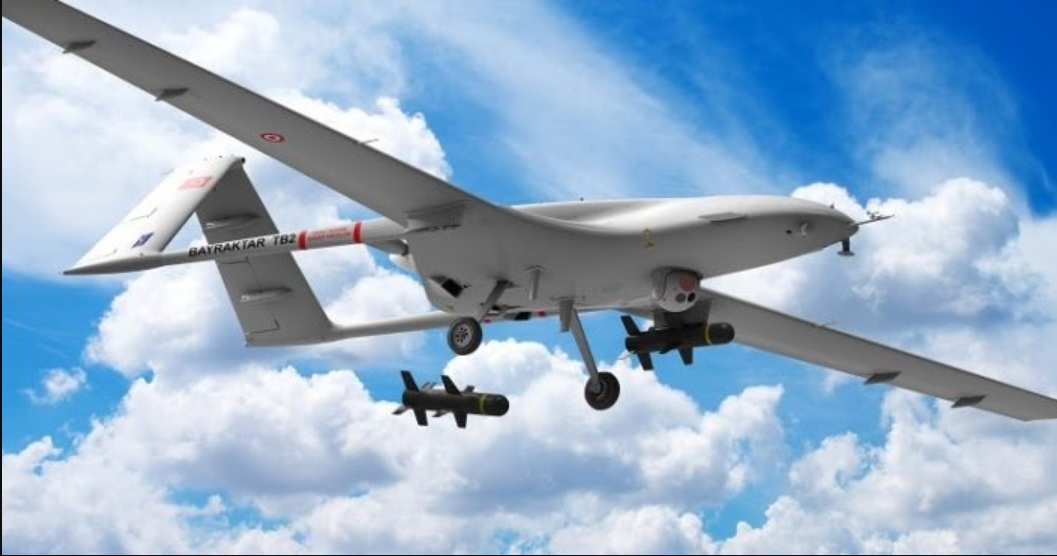
Bayraktar TB-2 (Redditt)


The answer could be that the drone can use for so-called "surgical strikes". And that means drones are useful also things like assassination missions. The thing is that drones are effective and dangerous tools is that they can be almost everywhere. Small UCAV drones can carry to operational areas even in the trunk of the car. 

And they can leave to the attack position. The drone can be a quadcopter or it can be aircraft-shaped like Boeing Dominator. So when the target is coming to the operational area it will go airborne. The aircraft-looking drone can use a balloon for lift-off. 

And the operator can make that strike from a long distance. That thing makes them very frightening. And the weapon systems must be frightening because they deny the attacks from foreign countries. The purpose of the military system is to put fear in the mind of enemies. And that thing makes all successful weapon systems rough, brutal and shocking. 


https://interestandinnovation.blogspot.com/


Monday, November 19, 2018

The new miniature drones are extremely dangerous in wrong hands


Picture I


Kimmo Huosionmaa

On the Internet have been stories, that the Russian new drones can jam any cell-phone by the distance of about 10 to 15 kilometers. Those drones can be equipped with ECM system, and they can interrupt any data communication, what have used the frequencies, what the operators would know. Those extremely small drones can throw to the air by hand or they can shoot by using crossbows or dropped from aircraft or helicopters. This makes those drones extremely sophisticated, and they can use in recon or attack missions by military personnel or undercover operators.

Sometimes those drones are equipped with the thermobaric warhead, and plainclothes agents can carry that equipment near the target, what might be the enemy radio station, ammunition storage or airfield. Those drones can operate remotely from the other side of the world. This means that those agents must only get those devices to air, and in that mission can use balloons, what would be filled by using the remote command. When those drones are high enough the wires would cut and the operator would fly them against targets. Use of balloons guarantees, that those agents must just leave those weapons to the ground, and flee away.

Those drones can be controlled by cell phones, what communicates with the guidance unit, and that thing is actually normal radio-amplifier, and the idea of the controlling system is similar to WLAN, but it uses more powerful radio transmissions than the normal WLAN. This kind of system could be installed to radio telescopes, and the idea is that the other side receiver-transmitters must be powerful, and the drone can be operated from another side of the Earth by using this kind of remote systems. When we are thinking about those miniature drones, they can also be equipped with explosives, and use small sizer cruise missiles.

If those small size cruise missiles are equipped with HEAT warheads, they can destroy even the tank or those systems like RQ-11 can have the thing like "frag grenades", what means thermobaric hand grenades, what has killing radius almost 30 meters. Thermobaric ammunition can installed easily to those miniature drones. And also the force of the HEAT-warhead can boost by filling the empty space ahead of the explosive hydrocarbon like gasoline or propane, what makes those ammunition extreme powerful. Sometimes the small size FAE warheads are only the HEAT ammunition, what are equipped with ventile, what can be used to fill that ammunition by aerosol, and the Russian RPG-7 has sometimes this capacity. 

Picture I

https://en.wikipedia.org/wiki/AeroVironment_RQ-11_Raven

Thursday, October 11, 2018

The capacities of "Lark"


Heinkel "Lark"
(Picture I)


Kimmo Huosionmaa

Heinkel "Lark" ("Lerche") (or Wasp "Wespe") was one of the Nazi-Germany's last plans to change the route of the War against allied nations, and this is the official truth about this plane. But in fact there is a question, about this plane, that is this plan made actually some American team and was the purpose of this VTOL-plane only be that it should give the reason for recruiting Nazi-scientists after World War II because the western allies didn't want that those scientists would go in hands of the Soviet Union.  The structure of those aircraft would be very interesting, and if there would be the pike in the nose and the rim around it would be used as the generator, would that thing make this aircraft the electromagnetic weapon, what would use the pike to target that weapon, what might use radio- or microwaves to terminate the target.

But there are many strange details of that thing. Do you know, that "Lark" actually could fly in space, if it would use magneto dynamic driving propulsion? In this scenario, the rim, what would surround the body of this aircraft would be equipped with the magnetic accelerator, what would suck ions thru it. There are actually three ways to give electric power to that system. One is used power-cells or turbo generators, what would use oxygenated fuel.

Second is to use the nuclear reactor and the last one could be pumping the external radio waves or other electromagnetic radiation to that vehicle, what might use that electricity as the wireless electric transmitter. Or if the planner of that vehicle would want, this person might install the normal rocket to that vehicle, and when the propel would rise this plane very high altitude, the rocket would rise it out of the atmosphere, but the electromagnetic drive would give more possibilities than the normal rocket. And in that metal rim would, in fact, conduct so sturdy magnets, that the WARP-drive could be possible if the power system uses a nuclear reactor for creating the electricity. That would raise the voltage so high, that the WARP-drive would be possible. The system would not necessarily drive the spacecraft faster than light, but it can open the gates to all solar system.

This kind of system really needs the very high voltage of electricity. And that's why it must equip with the nuclear reactor or the electric power must transfer to it by using high-power maser-system. In the last system, the electric power would transfer to the system by using electromagnetic radiation, what can be given by using extreme high-power radios, what I have written somewhere else.

But when we are thinking about the flying with propels, we might think that the propels would take the aircraft to the extremely high altitude, and then the rocket motor or electromagnetic drive would be started, and that motor would raise the aircraft to the orbital trajectory. The shape of the "Lark" has given the innovation to some very small size drones, what are actually the flying antitank weapons. In this case, the portable antitank missile like "Dragon", would be put in the tube, where is installed the opposite rotating propels, what is seen in the drawings of "Lark".

This system can be very devastating against helicopters and tanks. It can be dropped from the aircraft or some other platforms like helicopters. The idea of that thing, what might be called as the "Mini Lark" is some sci-fi action movies, and I don't know who has made those things. But they are the very interesting way to see the capacity of the military drones. Those weapons can fly to the battlefield and operate against tanks and other vehicles.

Sources:

https://hubpages.com/education/Hitlers-Heinkel-Lerche-The-First-VTOL-Aircraft

https://en.wikipedia.org/wiki/Warp_drive

Picture I

https://i.pinimg.com/originals/3d/ba/51/3dba515a8f9db10fe8d78bd1cd7d1585.jpg

Saturday, September 8, 2018

Kinetic energy bombardment is the new threat in the military world


Picture I
Kimmo Huosionmaa

X-37B is a small size space-shuttle, what is a very mysterious creature in the skies. The shuttle itself offers a platform for modular systems, and one of the most feared military solutions is the so-called kinetic energy missiles. Those missiles can installed in X-37B very easily, and the shuttles manipulator hand can be used to operate that thing. The system could be actually the rocket drum, what is normally installed to helicopter or aircraft, and those rockets can equip with concrete profiles, what would keep them shapes in extreme heat, what causes the rocket hits the atmosphere, and the resistance of the atmosphere would heat that projectile in very high temperature. 


This kind of solutions bases everyday technology, what would put in the new environment. The kinetic-energy bomber should not actually be a big size or complicated system. And sometimes "Mercury" capsule is actually the early version of the kinetic energy bomber. That system could be simple like the flying rocket mortar, what would shoot the rockets very sharply in some targets. In the Soviet "Almaz" program was planned to install 20-30 mm. aircraft cannons in the spacecraft. That ammunition would equip with the ceramic nucleus. And that would allow making even the river on the ground. 


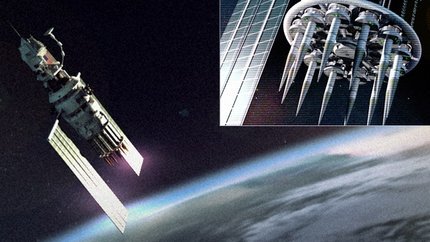
There have been stories of the United States giant kinetic energy bombardment system, what was called "Project Thor". Many times there were claiming, that "Thor" was railgun or electromagnetic gun, what is installed in some satellite.  But in the real life that electromagnetic system would not be necessary, and many times I have thought that this system would be the giant airgun. Those pressure base space-cannons are actually similar that the cannons, what is used in the normal combat situations, and they can be very effective. 


The ammunition, what would be metal tungsten, will shoot to target by pressure, what is made by burning hydrogen and oxygen in the combustion chamber, and if the same force would be targeted to opposite direction, would that keep the satellite in the direct position. Sometimes the weapon like "Thor" is suitable for making channels in the dry areas, and that's why it should be classified as the mining equipment. The United Nations have prohibited those weapons, but the nuclear weapons and other weapons of mass destruction are also prohibited. The contracts prohibit the MIRV or multi-warhead missiles. And any nuclear state is going to limit their arsenals, and the development of the new nuclear missiles is going on. 

Picture I

Microwave weapons are excellent tools for affecting entire drone swarms.

Microwave weapons. They are directed energy weapons (DEW). Those weapons use microwaves to affect targets. That effect is needed. When. The ...